
Introduction
If you've been shopping for a dash cam lately, you've probably come across features like Wi-Fi, GPS, and LTE. While Wi-Fi and GPS are easy enough to understand, LTE tends to leave many drivers wondering what it actually does—and whether it's worth paying for.
Does an LTE dash cam need a SIM card? Can you monitor the status of your vehicle remotely in real time? How is LTE different from Wi-Fi? More importantly, do you actually need it?
In this guide, we'll explain everything you need to know about LTE dash cams, including:
· What LTE means
· How LTE works
· Why LTE is important for modern dash cams
· How to choose the best LTE dash cam
· Which LTE Dash Cam Is Right for You?
What Is an LTE Dash Cam?
LTE turns your dash cam into a connected device that stays online even when you're away from your vehicle.
Unlike a standard Wi-Fi dash cam that only connects when you're nearby, an LTE dash cam uses a dedicated LTE module and a SIM card to access the cellular network independently. This allows the camera to communicate with your smartphone from virtually anywhere, not just within Wi-Fi range.
With an LTE connection, your dash cam can:
- View your vehicle remotely through Live View
- Receive real-time parking alerts
- Track your vehicle's GPS location
- Download important video clips remotely
- Automatically upload collision footage to the cloud
- Access your vehicle anytime through the Vantrue App
- Geo-Fence Alerts — Set a virtual boundary and get notified if your vehicle enters or leaves the area.
- Video Call—Speak through your dash cam using the Vantrue app.
In short, LTE doesn't improve video quality—it improves accessibility, allowing you to stay connected to your vehicle wherever you are.
How Does an LTE Dash Cam Work?
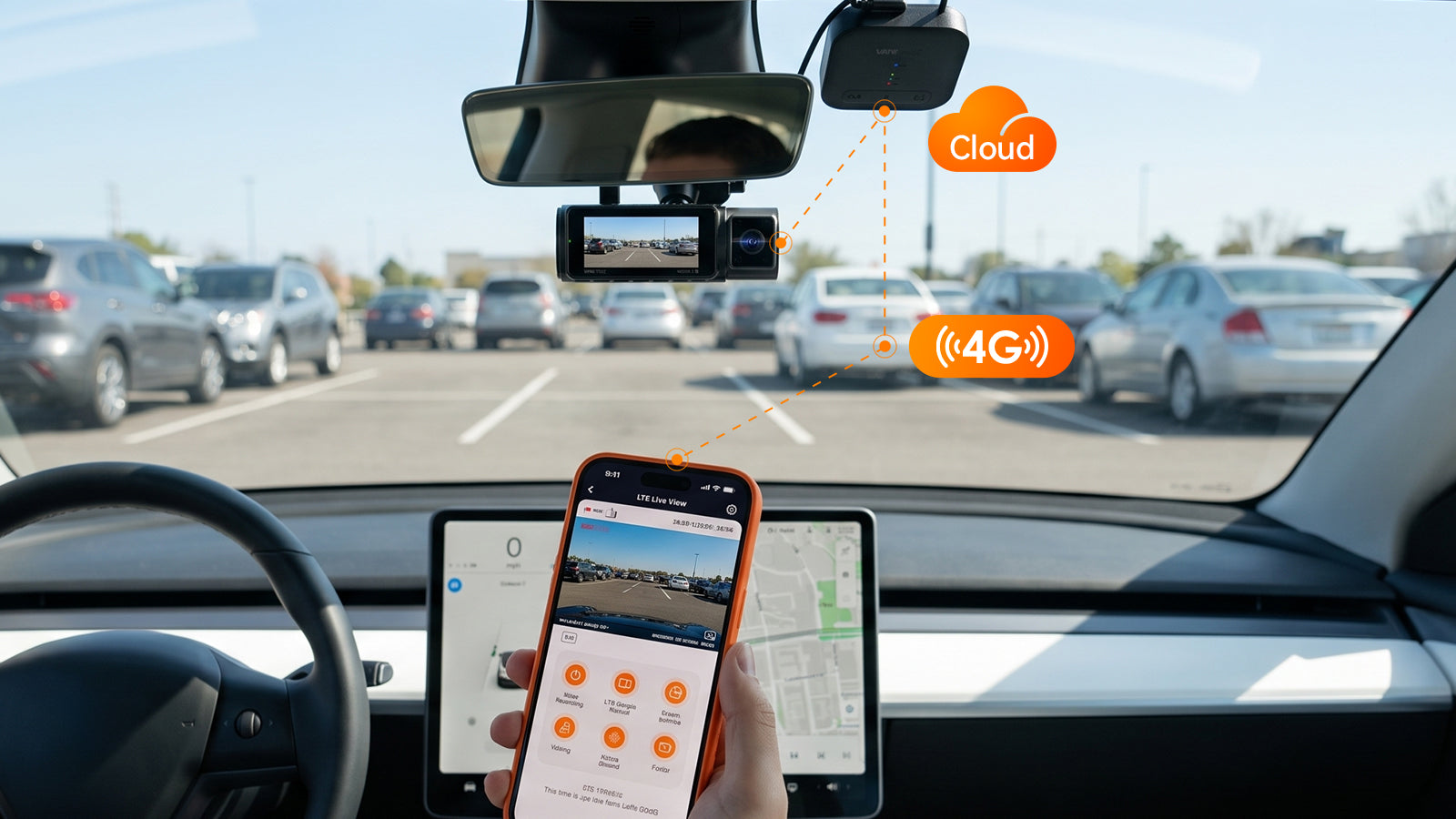
An LTE dash cam works by combining four key components:
1. LTE Module
The dash cam connects to an external LTE module (LT01), which provides cellular connectivity.
2. SIM Card & Data Plan
The LTE module contains a SIM card with an active data plan, allowing the dash cam to access the mobile network without relying on nearby Wi-Fi. Data plans are activated through the Vantrue App.
3. Continuous Power
For remote monitoring while parked, the dash cam must remain powered through a hardwire kit connected to your vehicle's fuse box. The built-in supercapacitor is designed for safe operation but cannot power LTE functions on its own.
4. Vantrue App
Once connected, the dash cam continuously communicates with the Vantrue App over the LTE network. Whenever a parking event, collision, or vehicle movement is detected, the dash cam sends the information through the cellular network to the cloud, which then delivers notifications and remote access to your smartphone.
The connection process

Why Is LTE Important for Modern Dash Cams?
While both LTE and standard dash cams record driving footage, they serve different purposes.
A traditional dash cam focuses on capturing evidence locally, while an LTE dash cam adds real-time connectivity, remote access, and instant notifications that help you stay informed even when you're miles away.
Here's a side-by-side comparison.
|
Feature |
Non-LTE Dash Cam |
LTE Dash Cam |
|
Local Recording |
✅ |
✅ |
|
Parking Mode |
✅ |
✅ |
|
Instant Alerts |
❌ |
✅ |
|
Remote Live View |
❌ |
✅ |
|
Remote Video Download |
❌ |
✅ |
|
Cloud Backup |
❌ |
✅ |
That difference may not seem important—until the moment you actually need it.
• Someone hits your parked car. A standard dash cam records the impact. An LTE dash cam also sends an instant alert to your phone.
• You want to check on your vehicle. Wi-Fi only works when you're nearby, while LTE lets you view your camera remotely.
• Your car is moved or stolen. Instead of discovering it hours later, you can check its location and access footage remotely.
• You need an important video clip. LTE lets you download it without returning to your vehicle.
Here's how an LTE dash cam compares to a standard dash cam in everyday use:
|
Everyday Situation |
Standard Dash Cam |
LTE Dash Cam |
|
Parking incident |
Records locally |
Records + instant alert |
|
Checking your car |
Must be nearby |
Remote Live View |
|
Vehicle theft |
No remote tracking |
GPS location & remote access |
|
Getting footage |
SD card or Wi-Fi |
Remote download |
How to Choose the Best LTE Dash Cam?
When comparing LTE dash cams, don't get lost in the specs. Instead, ask yourself three simple questions:
✔ Will it notify me when something happens?
Real-time parking alerts and remote live viewing are what make LTE truly valuable.
✔ Will my footage still be available?
Cloud backup can help preserve important recordings, even if the camera is damaged or stolen.
✔ Does it fit the way I drive?
Choose a model based on your driving habits—not just the number of cameras or features.
Which LTE Dash Cam Is Right for You?
Once you've decided that LTE is the right fit, the next step is choosing a setup that matches how you drive.
|
Best for |
Recommended Bundle |
Why it's a good fit |
|
Uber & Lyft drivers |
Dual-channel recording with cabin coverage, ideal for rideshare drivers who want remote monitoring and added protection. |
|
|
Daily commuting |
Triple-channel recording with front, cabin, and rear coverage—an excellent all-around choice for most drivers and families. |
|
|
SUV / Large vehicle / Fleet |
Four-camera coverage with LTE connectivity, designed for SUVs, family vehicles, and anyone who wants the most complete protection available. |
All bundles support LTE-powered features through the LTE Module, including remote live view, parking alerts, cloud connectivity, and real-time vehicle location.
Conclusion
The best LTE dash cam isn't necessarily the one with the most cameras—it's the one that fits the way you drive. Whether you need a simple commuter setup or full four-channel coverage, choosing a model with LTE can give you access to features that continue working long after you've parked your car.
☞ Explore the Vantrue LTE lineup to find the setup that best fits your driving needs.
Frequently Asked Questions
What does LTE stand for?
LTE stands for Long-Term Evolution, a wireless communication standard that powers most modern 4G cellular networks.
Is LTE the same as 4G connectivity?
Not exactly. LTE is the technology behind most 4G networks, so the two terms are commonly used interchangeably.
Is LTE better than Wi-Fi?
They serve different purposes. Wi-Fi is ideal for local, high-speed connections, while LTE allows devices to stay connected wherever cellular service is available.
Does an LTE dash cam need a SIM card?
Yes. Most LTE dash cams require a SIM card or an integrated cellular data plan to access remote features such as live view, cloud storage, and instant notifications.
Is LTE still worth it in 2026?
Absolutely. LTE continues to provide excellent coverage, reliable performance, and sufficient speed for smartphones, IT devices, and connected dash cams, making it a practical choice for everyday use.
Share:
Why Didn't My Dash Cam Record It? 5 Hidden Problems Most Drivers Overlook
What Is a Thermal Dash Cam? Everything You Need to Know Before You Buy