
Quick answer:
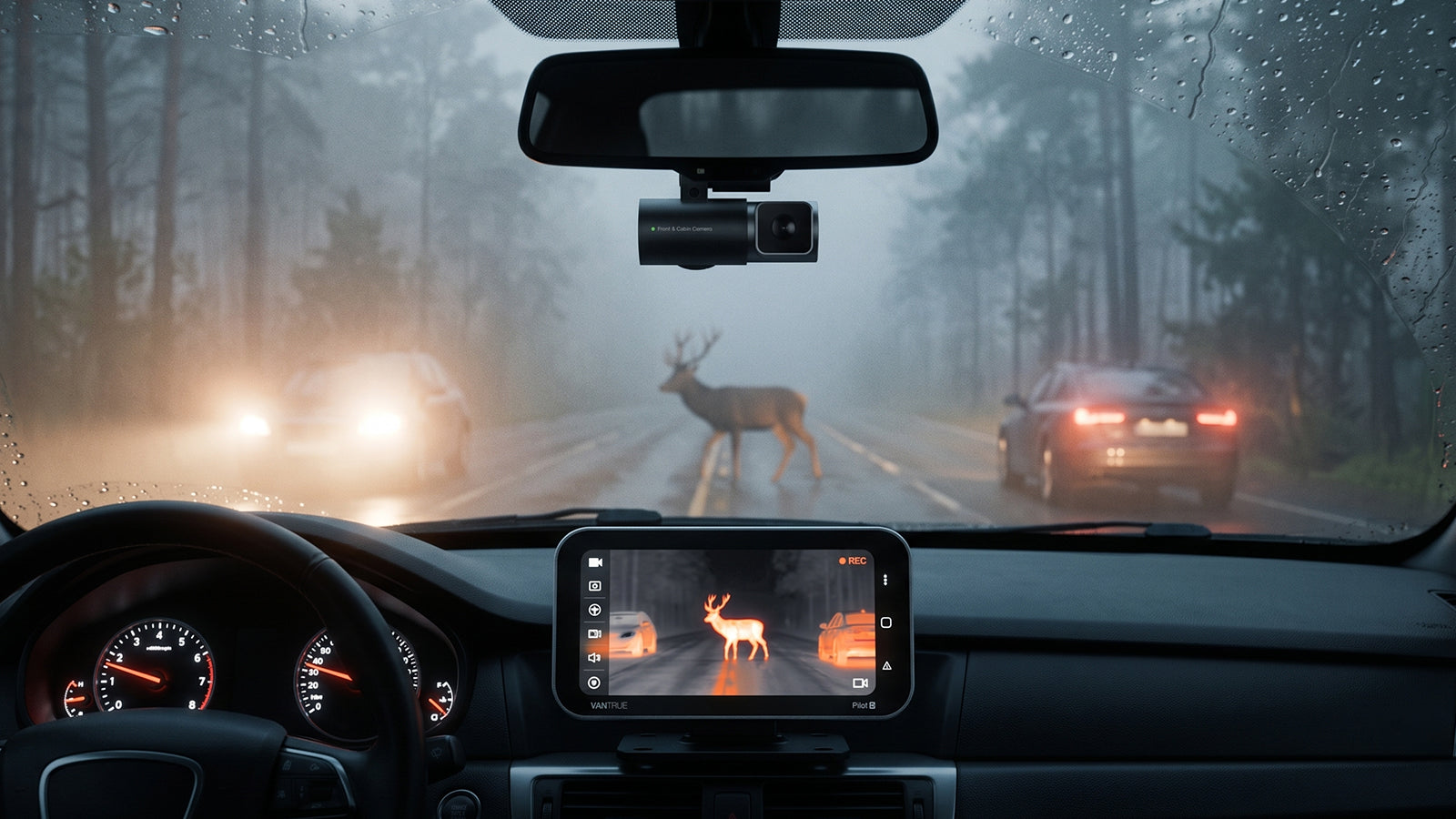
Extended Vision: Detects heat signatures 4x farther than standard high beams, piercing pitch-black darkness, heavy dust, fog, and dense foliage.
HD Thermal Clarity: 4x Super-Resolution algorithm transforms native thermal feeds into crisp 1024×768 HD video.
Long-Range AI Detection: Automatically identifies vehicles up to 100 meters (328 ft) and wildlife or pedestrians up to 70 meters (230 ft).
Accident & Loss Prevention: Grants critical reaction time to avoid high-risk collisions, saving ~$20,000 per crash.
All-in-One Utility: Provides early vehicle mechanical overheating alerts and 24/7 campsite perimeter security.
Introduction
Widespread across the US, 1 to 2 million annual wildlife-vehicle collisions cause about 200 human deaths, over 26,000 injuries, and over $10 billion in total costs, averaging $20,000 per deer crash.
The Solution: Thermal AI vs. Traditional Night Vision
Integrating a vehicle-mounted thermal camera like the Vantrue Thermal Dash Cam transforms night driving from a gamble into a controlled experience. Unlike standard dashboards or infrared night vision cameras that rely on reflected ambient light, thermal sensors detect invisible heat radiation.
Vantrue’s 4x Super-Resolution Algorithm upscales a native 256×192 thermal resolution into crisp 1024×768 HD thermal video, piercing through pitch-black darkness, dust clouds, thick fog, and forest cover to display clear heat profiles far beyond headlight range.
Proactive AI Safety: 100M Real-Time Hazard Detection Rather than forcing you to constantly stare at a screen, Vantrue’s smart thermal algorithms actively scan the road ahead and highlight hazards with color-coded warning bounding boxes:
Vehicle Collision Detection (Up to 100m / 328 ft): Tracks preceding traffic and obstacles. Normal tracking displays in green; high collision risk triggers a prominent red warning box.
Pedestrian & Cyclist Detection (Up to 70m / 230 ft): Identifies unlit walkers and cyclists on dark roads, highlighting collision risks with an orange warning box.
Quadruped Wildlife Detection (Up to 70m / 230 ft): AI algorithms specifically trained to identify deer, bears, elk, horses, cows, dogs, and kangaroos, alerting you to sudden road entries with a blue warning box.
| Risk Scenario | Avg. Cost WITHOUT Thermal | Cost WITH Vantrue Thermal | Estimated Savings |
|---|---|---|---|
| Major Wildlife Collision (Deer/Elk) | ~$20,000 | $0 (Proactive AI braking) | ~$20,000 |
| Wildfire Smoke / Dust Blindness Crash | ~$8,500 | $0 (Pierces smoke & dust) | ~$8,500 |
| Unseen Trail Hazard (Boulders/Washouts) | ~$5,500 | $0 | ~$5,500 |
| Insurance Premium Hike (3-Year Impact) | ~$3,000 | $0 (Video evidence) | ~$3,000 |
| Total Potential Savings | $37,000 | - | $37,000 |
24/7 Campsite & Outdoor Surveillance
The protection continues when the ignition is off. Parked at a remote campsite, a thermal dash cam functions as a perimeter security guard. Overlanders can scan pitch-black surroundings for predatory animals or uninvited guests right from the safety of the cabin—no flashlight required.
Piercing Wildfire Smoke & Severe Obstructed Visibility
During wildfire season or extreme off-road expeditions, dense smoke, trail dust clouds, and heavy fog can reduce driving visibility to zero. While standard high beams reflect off airborne ash and particulates—blinding the driver—Vantrue’s thermal imaging cuts directly through wildfire smoke and harsh environmental obstruction.
It reveals the road layout, stalled vehicles, fallen trees, and fleeing wildlife hidden inside dense smoke plumes long before they become visible to the human eye.
Post-Accident Proof
Indisputable Insurance Evidence: If an unavoidable animal strike or rollover occurs, thermal footage provides undeniable proof of sudden hazards, accelerating claims and protecting safe-driver ratings.
Conclusion: Drive Smarter and Protect Your Investment
In an era of rising vehicle repair costs and insurance premiums, a vehicle-mounted thermal dash cam is no longer a luxury—it is an essential safety policy for outdoor enthusiasts. By combining long-range AI heat detection, 4-channel SONY STARVIS 2 recording, mechanical diagnostic scanning, and 24/7 campsite surveillance, thermal imaging converts night-driving hazards into total situational awareness.
Vantrue thermal dash cam preserves your rig, protects wildlife, and ensures that you return home safely from every adventure.
Ready to see what’s lurking in the dark? Explore the Vantrue Thermal Dash Cam series today and upgrade your off-road defense.
Frequently Asked Questions
Q1: How far can the AI smart thermal camera detect wildlife and vehicles?
The system detects preceding vehicles up to 100 meters (328 ft) away and identifies quadruped wildlife (such as deer, elk, and bears) and pedestrians up to 70 meters (230 ft) away, displaying visual warning bounding boxes to alert you in real time.
Q2: What is the 4x Thermal Super-Resolution Algorithm?
Thermal sensors typically capture images at lower native resolutions (like 256×192). Vantrue’s onboard 4x Super-Resolution algorithm processes and sharpens the thermal feed into a higher-definition 1024×768 video output, allowing you to discern smaller animals and distant trail obstacles much earlier.
Q3: How does a vehicle thermal camera differ from standard infrared night vision?
Standard night vision amplifies visible light or relies on infrared LEDs, which can be blinded by fog, heavy dust, or ambient headlights. Thermal cameras measure emitted heat signatures rather than reflected light, making them unaffected by adverse weather, blinding glare, or total darkness.
Q4: Can a thermal dash cam really help with automotive diagnostics?
Yes. Thermal sensors visually map temperature variations. Off-roaders can use thermal imaging to easily spot dragging brake calipers, failing wheel bearings, clogged cooling systems, or overheating differentials before they cause mechanical failure on remote trails.
Q5: Can a thermal dash cam really see through wildfire smoke and heavy fog?
Yes. Standard headlights scatter light when hitting airborne ash, dust, or water droplets, causing severe visual blinding. Because thermal imaging detects emitted heat radiation rather than reflected visible light, it bypasses smoke particulates and dense fog, providing a clear visual field during emergency wildfire evacuations or dusty trail navigation.
Share:
Are Dashcams Battery Powered? A Simple Guide
How to Hardwire a Dash Cam for Parking Mode