
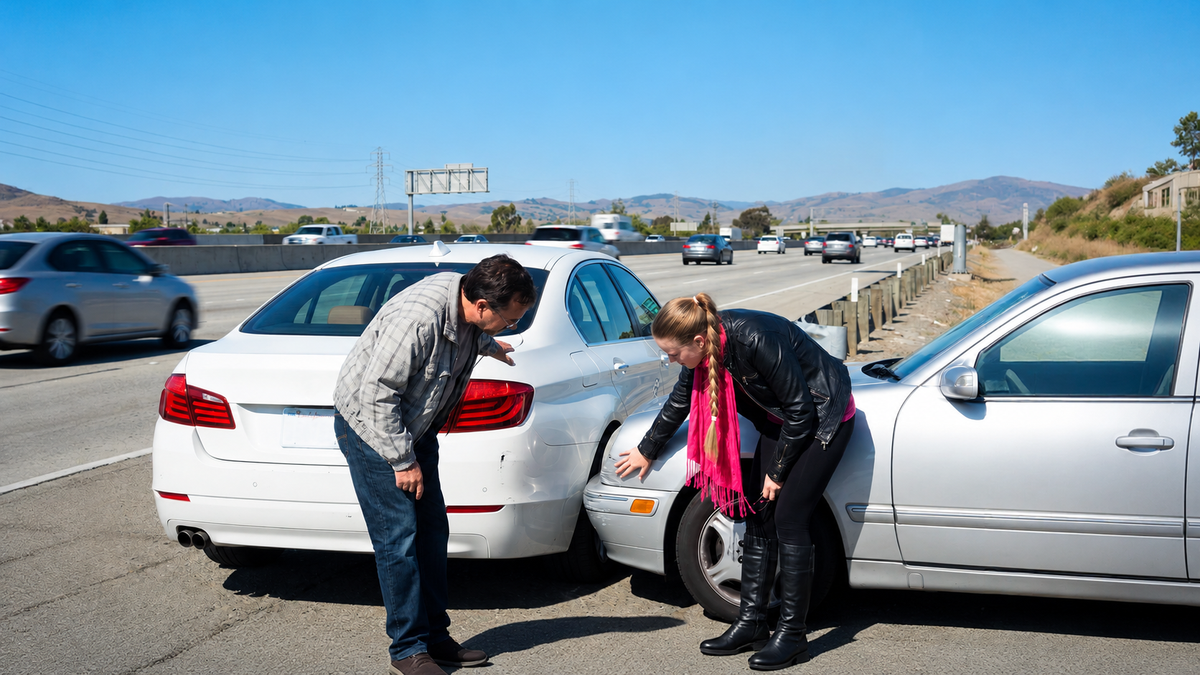
Crash-for-cash fraud has been a concern for UK insurers and police for years, but recent warnings suggest the tactics are becoming more varied.
A suspicious collision might begin with a car braking sharply on a clear road, a driver waving you through before moving into your path, or a moped appearing unexpectedly from a blind spot.
“Crash for cash” is insurance fraud in which an accident is deliberately staged, induced or fabricated to support fraudulent claims.
In August 2026, the City of London Police’s Insurance Fraud Enforcement Department (IFED) said it had investigated more than £25.3 million in suspected crash-for-cash fraud over the previous five years.[1]
For motorists involved in a suspicious collision, evidence can become crucial. Dash cam footage can preserve a record of what happened when the people involved give very different accounts.
At a Glance
-
Crash-for-cash fraud includes staged, induced and fabricated accidents.[4]
-
Police say newer tactics include moped scams, roadside identity theft and inflated repair claims.[1]
-
After a suspicious collision, save your footage, record the vehicle details and contact your insurer.
What Is a Crash-for-Cash Scam?
The Association of British Insurers (ABI) identifies three main types.[4]
Staged accidents
The collision is arranged between people already involved in the fraud, followed by claims for injuries, vehicle damage or other losses.
Induced accidents
An unsuspecting motorist is deliberately placed in a situation where they appear responsible.
This might involve a vehicle braking sharply, driving with disabled brake lights, or signalling another driver through a junction before moving into their path.[4]
Fabricated accidents
No genuine collision takes place. Fraudsters simply submit claims for accidents or injuries that never happened.
How Big Is the Problem in the UK?
IFED says it investigated more than £25.3 million in suspected crash-for-cash fraud over five years, with around 75% involving staged or induced collisions.[1]
Moped-related scams have also become a particular concern. City of London Police says more than 4,000 people were targeted between June 2021 and July 2024, with associated fraudulent insurance claims estimated at £70 million.[2]
|
UK Crash-for-Cash Data |
Reported Figure |
|
Suspected fraud investigated by IFED over five years |
£25.3M+ |
|
Cases involving staged or induced collisions |
Approx. 75% |
|
People targeted in moped-related incidents |
4,000+ |
|
Estimated fraudulent claims linked to those incidents |
£70M |
Victims can face more than repair costs. The ABI notes that innocent motorists may lose their no-claims bonus and see insurance premiums rise.[4]
A Recent UK Crash-for-Cash Case
Crash for cash returned to the headlines in September 2026 with the sentencing of former Metropolitan Police officer Kuldip Singh.
According to the Crown Prosecution Service (CPS), Singh was involved in pre-arranged vehicle collisions followed by fraudulent personal injury and vehicle damage claims.[3]
On 18 September 2026, Southwark Crown Court sentenced him to four years and five months in prison.[3]
The case involved collisions arranged between participants in the scheme rather than an innocent motorist being deliberately targeted. Even so, it shows how an apparently ordinary road accident can become the basis of a wider insurance fraud.
How Crash-for-Cash Scams Are Changing
Traditional induced collisions still occur, but City of London Police says the fraud is evolving beyond the crash itself.[1]
Moped scams
Police have warned about riders waiting near junctions or residential roads before moving into a motorist’s path.
A rider may approach from a blind spot, claim injury after the collision or pressure the motorist for payment.[1][2]
Roadside identity theft
Criminals may also ask to photograph or copy a motorist’s driving licence after a collision.
City of London Police says motorists should exchange the information required after an accident, but there is no need to allow another person to photograph or copy a driving licence.[1]
Inflated repair claims
Dishonest garages can also become part of the fraud by inflating repair costs after a collision.[1]
This is why photographs and video from the scene can remain useful even after the vehicles have left.
How Can Dash Cam Footage Help?
Dash cam footage provides something that memory alone cannot: a visual record of the sequence of events.
City of London Police advises motorists to consider using a dash cam capable of producing clear, timestamped footage.[1] Its wider guidance also says front and rear recordings can help identify fraudulent claims and support police investigations.[2]
Front footage might show a vehicle braking sharply despite a clear road ahead. Rear footage can show how another vehicle approached before impact. Additional camera angles may capture a moped or vehicle approaching from outside the main camera’s view.
For that reason, broader camera coverage can be useful when a collision develops around more than one side of the vehicle. Vantrue offers front-and-rear, 3-channel and 4-channel dash cam systems designed to record multiple areas around a vehicle at the same time.
The footage can then be reviewed alongside photographs, witness details and vehicle damage.
What Footage Should You Save?
Do not save only the moment of impact.
Keep footage covering the lead-up, collision and aftermath.
Before the collision, the recording may show sudden braking, unusual changes in speed or another vehicle moving into your path.
During the impact, it may capture vehicle position, road conditions and, where image quality allows, registration details.
Afterwards, footage may show where the vehicles stopped, whether one was moved, any altercation, or whether another road user left before details were exchanged.
Image quality also matters. Selected Vantrue models combine multi-channel recording with HDR, low-light performance and enhanced number-plate capture features such as PlatePix™, helping preserve more detail in difficult lighting conditions.
The goal is simple: keep enough footage to show how the incident unfolded.
What Should You Do After a Suspicious Collision?
If something about the incident seems unusual, focus on four steps.
1. Get to a safe position
Prioritise safety and avoid confronting the other driver or rider about suspected fraud.
2. Record the details
Note the vehicle registration, make and model, time, location and any witness information.
Where safe, photograph the vehicles, visible damage and the surrounding road scene.[4]
3. Save your footage
Protect the recording before loop recording overwrites it.
Keep the original footage from before, during and after the incident.
4. Contact your insurer
Tell your insurer what happened and explain anything that appeared unusual.
Suspected fraud can also be reported to the police and through the Insurance Fraud Bureau’s CheatLine.[2][4]
City of London Police also advises motorists not to hand over cash or banking details at the roadside and not to allow another person to copy or photograph their driving licence.[1]
Always call 999 in an emergency.[2]
Crash-for-Cash FAQs
What does “crash for cash” mean?
It is insurance fraud in which an accident is deliberately staged, induced or fabricated so that fraudulent claims can be made.[4]
What are common warning signs?
Sudden braking without an obvious reason, unusual changes in speed, a driver signalling you through before moving into your path, or a moped appearing unexpectedly from a blind spot can all be warning signs.
Pressure to hand over cash or unnecessary personal information after a collision should also raise concern.[1][4]
Can dash cam footage help with an insurance claim?
Yes. Dash cam footage can be submitted as part of the evidence surrounding a collision. City of London Police says recordings can help identify fraudulent claims.[2]
Should I let another driver photograph my driving licence?
No. Police guidance says there is no need to allow another person to photograph or copy your licence after a collision.[1]
What should I do if I suspect crash-for-cash fraud?
Move somewhere safe, record the vehicle details, photograph the scene, save your footage and contact your insurer. Suspected fraud can also be reported to the police and Insurance Fraud Bureau.[2][4]
Vantrue Dash Cams for Broader Road Coverage
Different driving situations call for different levels of coverage.
Front + Rear Dash Cams
Record the road ahead and traffic approaching from behind.
3-Channel Dash Cams
Add another view, such as the cabin, alongside front and rear recording.
4-Channel Dash Cams
Provide broader coverage around the vehicle when an incident develops outside a single camera’s field of view.
Vantrue’s multi-channel range includes models such as the N4 Pro / N4 Pro S for front, cabin and rear recording, and the N5 / N5S for wider 4-channel coverage.
Sources
[1] City of London Police—Driver warning issued as crash for cash evolves and puts identity data at risk, 5 August 2026.
[2] City of London Police — ‘Crash for cash’ fraud.
[3] Crown Prosecution Service — UPDATED WITH SENTENCE: Former police officer jailed for involvement in fraudulent ‘crash for cash’ scam, 18 September 2026.
[4] Association of British Insurers — Crash for cash.
Further Reading
[5] ITV News—Inside the multi-million-pound world of ‘crash for cash’ scams, August 2026.
[6] Allianz Insurance — How to steer clear of ‘crash for cash’ scams, 22 April 2026.
Dele:
Vantrue Privacy Mode Updated: The Most GDPR-Compliant Dashcam in Europe.